
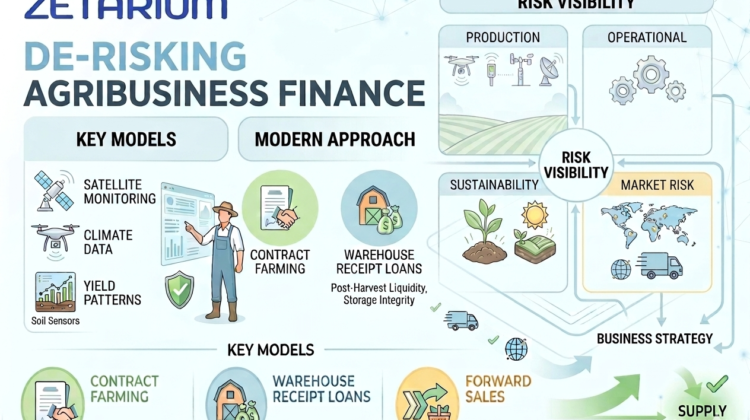
How Agribusinesses Can De-Risk Contract Farming, Warehouse Receipt Loans, and Farmer Financing at Scale
Introduction: The Real Risk in Agribusiness Finance
For agribusinesses, the challenge is not simply buying crops or issuing inputs. The real challenge is financing production without creating hidden credit risk.
Food factories, crop traders, and contract farming operators often extend value to farmers long before harvest. They provide inputs, advance payments, technical support, or guaranteed offtake agreements in order to secure future supply. In practice, this makes them part buyer, part financier, and part risk manager.
That is where many agribusiness models break down.
When farmer financing is structured without proper risk visibility, the result is predictable: side-selling, delayed delivery, default on input repayment, inconsistent quality, and supply disruption at harvest. The issue is not only financial. It is operational, commercial, and strategic.
Agribusinesses that want to scale contract farming must treat farmer financing as a risk discipline, not just a procurement tool. That means understanding farmer capacity, production risk, storage risk, and market risk together. Industry needs to de-risk agribusiness finance for contract farming & forward sales, warehouse receipt loans, and other fiscal tools to maintain its robustness and sustainability.
This is the same logic behind our four-layer agricultural risk framework, which separates different risk factors instead of compressing everything into one blunt score.
Contract Farming Works Best When Credit Is Built In
Contract farming is an agreement between farmers and buyers (such as food companies or traders) where production and supply terms are predefined before planting.
Typically, the mechanism includes:
- The buyer specifies crop type, quantity, and quality standards
- The farmer commits to producing and delivering under those terms
- The buyer often provides support such as inputs, technical guidance, or price guarantees
At its core, contract farming is designed to reduce market uncertainty for farmers and secure supply for buyers.
However, the model depends heavily on execution at the farm level.
To fulfill a production commitment, farmers need working capital for seeds, fertilizers, labor, irrigation, and crop protection. Without access to credit, farmers often underinvest or delay critical inputs, which directly affects yield and quality.
This is the structural weakness.
Contract farming is not just a supply agreement. It is a financing structure embedded in a commercial relationship. When credit is insufficient or poorly aligned:
- production quality declines
- delivery commitments become unreliable
- side-selling increases
- default risk rises
In other words, weak credit undermines the entire contract.
The Core Limitation: Lack of Risk Differentiation
Most agribusiness contract farming models apply uniform structures across farmer groups.
This creates three major issues:
1. No Differentiation Between Farmers
High-performing farmers and high-risk farmers are treated the same.
2. Reactive Risk Management
Problems are only identified after:
- crop failure
- missed delivery
- repayment issues
3. Informal Decision-Making
Reliance on field officers and relationships leads to:
- inconsistency
- lack of scalability
- limited data transparency
At scale, this results in systemic inefficiency and hidden credit exposure.
Warehouse Receipt Loans: Useful but Structurally Limited
Warehouse receipt loans are commonly used to provide liquidity after harvest.
The mechanism works as follows:
- Farmers store harvested crops in certified warehouses
- They receive a warehouse receipt as proof of ownership
- This receipt is used as collateral for short-term financing
This system helps:
- Delay forced selling
- Improve post-harvest liquidity
- Support better price realization
However, it has clear limitations.
First, it addresses post-harvest liquidity, not production risk. By the time crops are stored, the most critical risks have already materialized.
Second, it depends heavily on storage integrity. Weak governance can lead to quality deterioration, fraud, or duplicate receipts.
Third, it does not assess farmer capability. It does not capture management quality, input decisions, or climate exposure.
Fourth, price risk remains. Farmers are still exposed to market volatility even after storage.
For agribusinesses, warehouse receipt lending is supportive, but it cannot serve as a standalone risk management solution.
Forward Sales: A Growing Model That Depends on Credit
Forward sales, also known as pre-harvest sales agreements, are increasingly used by traders and food companies to secure supply earlier in the production cycle.
How It Works
- The buyer agrees to purchase a future harvest at a predefined or formula-based price
- The farmer commits to delivering at a later date
- The agreement is made before or during the growing season
This creates price visibility for farmers and supply certainty for buyers.
The Critical Role of Credit
Forward sales only work when farmers can actually produce what they commit.
That requires:
- upfront investment in inputs
- working capital during the season
- flexibility to manage shocks
Without credit:
- farmers underinvest
- production falls short
- delivery risk increases
In this structure, credit is essential. It supports production capacity and ensures that contractual commitments can be fulfilled.
Forward sales align incentives early in the cycle, but without proper financing and risk assessment, they shift uncertainty from price risk to production and delivery risk.
From Collateral to Data: Building Real Risk Visibility
Agribusinesses rarely rely on collateral. Their exposure is operational:
- inputs provided
- contracts signed
- supply commitments made
To manage this exposure effectively, they need risk intelligence, not just financial records.
Modern approaches allow integration of:
- satellite-based crop monitoring
- weather and climate data
- historical yield patterns
- farmer behavioral data
This enables a shift from assumption-based decision-making to data-driven risk assessment.
A Multi-Layer Approach to Farmer Risk
A farmer’s ability to repay or deliver is influenced by at least four dimensions:
Production risk: land quality, rainfall, irrigation access, pest pressure, and yield variability.
Operational risk: farmer skill, input management, timing, and resilience under stress.
Sustainability risk: soil health, water use, and long-term productivity.
Market risk: commodity price changes, logistics disruption, and export or policy shocks.
These factors determine whether a farmer can deliver under a contract and whether an agribusiness can rely on that supply.
Static models fail because they ignore this complexity. Effective systems use structured and repeatable risk profiles that evolve over time.
From Transactions to Portfolio Management
The real transformation happens when agribusinesses shift from individual contracts to portfolio thinking.
Instead of asking whether a single farmer will deliver, they evaluate how groups of farmers perform under different conditions.
This enables:
- diversification across regions and crops
- early detection of systemic risks
- proactive intervention strategies
For a deeper perspective on risk as a strategic tool, see: →The Gate and the Compass
Conclusion: Financing Is the Foundation of Supply Stability
Contract farming, warehouse receipt loans, and forward sales are valuable tools, but none of them work effectively without strong credit structures and risk visibility.
Agribusinesses need a financing model that reflects the full reality of farming, including production risk, farmer capability, and market conditions.
This requires moving away from uniform structures and toward data-driven, risk-sensitive financing.
Organizations that treat farmer financing as a core capability will reduce supply volatility, improve performance, and scale more effectively.
The companies that master this will do more than reduce default. They will build more stable supply chains, improve farmer performance, and create a stronger commercial position across the agricultural value chain.
Part of a Larger Series
This article is part of a broader thread on credit and risk assessment in agriculture.
👉 Start with the foundation:
The New Architecture of Agricultural Credit: From Scoring to Data-Driven Risk Models
https://zetarium.com/new-architecture-agricultural-credit-data-driven-risk-models/
This is the first step in understanding how agricultural credit is evolving and how institutions can adapt.