
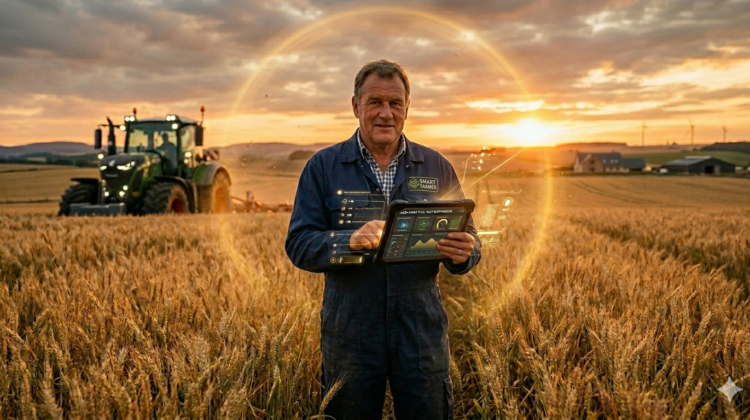
Where Is the Agency of Farmers?
Understanding Farmer Autonomy in Complex Agricultural Systems
Introduction: Are Farmers in Control of Their Own Future?
Modern agricultural systems are increasingly characterized by complexity, uncertainty, and interdependence. Farmers today operate within dynamic networks shaped by ecological processes, market structures, institutional arrangements, and sociocultural norms. These interconnected forces simultaneously generate opportunities and constraints, profoundly influencing production strategies, risk management, and long-term planning. As climate change, globalization, and rapid technological innovation intensify, farmers face mounting pressure to continuously adapt.
Within this evolving context, the question of farmer agency in agricultural systems becomes critically important. To what extent can farmers actively shape their production systems, livelihoods, and environmental outcomes? Are farmers primarily reactive actors constrained by structural forces, or do they retain the strategic capacity to influence agricultural trajectories?
This article argues that although farmers are deeply embedded within complex political, economic, social, technological, environmental, and legal systems, they retain significant agency in specific domains. By applying the PESTEL analytical framework, the paper systematically examines the external drivers shaping farming systems and identifies key areas in which farmers exercise autonomy, creativity, and strategic choice. In doing so, the article highlights the central role of farmer agency in advancing productivity, resilience, and sustainable agricultural development.
The PESTEL Framework: Mapping the Forces That Shape Farming
To locate farmer agency in agricultural systems, we first need to understand the structural environment farmers operate within. The PESTEL framework provides a systematic lens for examining the macro-environmental factors that shape farming decisions, risk exposure, and strategic options.
|
Factor |
Key Drivers |
Impact on Farmer Agency |
|
Political |
Subsidies, trade policies, regulatory frameworks, taxation |
Constrains short-term autonomy · Provides institutional stability for planning |
|
Economic |
Market concentration, price volatility, credit access, contractual arrangements |
Reduces bargaining power · Dominant downstream actors limit economic autonomy |
|
Social |
Consumer values, cultural norms, sustainability and ethical food preferences |
Creates differentiation opportunities · Requires strategic marketing adaptation |
|
Technological |
Mechanization, biotech, precision agriculture, digital platforms |
Enhances efficiency · High capital/knowledge barriers can create new dependency |
|
Environmental |
Soil fertility, water, climate shocks, biodiversity, long-term degradation |
Least controllable · Mitigated through adaptive management, diversification, insurance |
|
Legal |
Land tenure, labor law, food safety and environmental regulations |
Compliance costs · Also provides legitimacy, market access, consumer trust |
|
Farmers operate within a tightly structured institutional environment — yet the central question remains: within these constraints, where does genuine farmer agency reside? |
Locating Farmer Agency: Where Autonomy Emerges
Despite the complexity of external forces, many PESTEL factors remain relatively stable within any given agricultural season. Political and legal frameworks, technological infrastructures, and market institutions typically change slowly — providing a predictable enough context for short-term operational planning. Economic and social conditions fluctuate, but governments frequently intervene to stabilize agricultural markets. Environmental uncertainty remains the least controllable variable, though insurance schemes and adaptive technologies help contain its impact.
Within this structured context, farmer agency emerges primarily through knowledge acquisition, continuous learning, strategic decision-making, and innovation. Farmers who invest in education, skills development, and technological literacy are consistently better equipped to optimize production practices, manage risks, and improve long-term profitability — even under the same external conditions as their neighbors.
The Entrepreneurial Farmer: From Production to Strategic Management
Although farming is fundamentally a business, many farmers operate with limited managerial training and weak exposure to economic reasoning. Strengthening entrepreneurial capacity changes this. Farmers who develop business management skills can evaluate investments more rigorously, allocate assets more efficiently, and adopt technologies that genuinely enhance productivity — rather than following industry defaults or social norms.
It is worth noting that the most powerful driver of excellence in farming is often intrinsic motivation rather than external incentive. The farmer who genuinely wants to understand their soil, optimize their nutrient program, or master a new irrigation technology is operating from a fundamentally different position than one who merely complies with minimum requirements.
This is where individual agency in agricultural systems becomes most visible — and most impactful. Farmers who act as proactive managers, leaders, and innovators demonstrate that personal initiative can overcome significant structural constraints.
|
Significant productivity differences among farmers operating under identical environmental and institutional conditions highlight the critical role of individual decision-making — planting schedules, nutrient strategies, crop selection, and technology adoption all produce measurable yield gaps. |
A Real-World Example: The Borujerd Case
A compelling example comes from Borujerd, Iran, where a young farmer adopted science-based nutrient management practices in the face of strong local resistance. Despite social pressure from the farming community and reluctance from agricultural input suppliers, he followed expert recommendations — including zinc supplementation for wheat cultivation.
The result: yields nearly double those of neighboring farms during the 2025 agricultural season.
This case illustrates something fundamental about farmer agency in agricultural systems. It is not only about access to information or resources — it is about the willingness to act on that information against social and institutional resistance. By choosing knowledge-driven autonomy over conformity, this farmer shifted from heteronomy (dependence on external authority and social expectation) to genuine self-directed action, accepting full responsibility for his choices and producing a transformative outcome.
In rapidly changing agricultural markets, this kind of talent-driven leadership is not a luxury. It is essential. Empowering innovative farmers enables them to serve as catalysts for broader community transformation — fostering creativity, learning, and resilience across entire rural landscapes.
From Constraint to Capacity: What Farmer Agency Requires
Recognizing that farmers retain meaningful agency is only the starting point. The practical question is: what conditions allow that agency to flourish?
|
Enabler |
What It Delivers |
|
Education & Knowledge |
Access to evidence-based agronomic knowledge through extension services, universities, and digital platforms — not just input sales advice. |
|
Financial Instruments |
Agricultural insurance (especially parametric and index-based) gives farmers the foundation to invest, experiment, and absorb losses without falling into irreversible debt. |
|
Farmer Organizations |
Cooperatives, networks, and peer learning groups amplify individual agency — spreading innovative practices and increasing collective bargaining power. |
|
Participatory Governance |
Policy frameworks that treat farmers as active co-designers produce more effective and more durable agricultural transitions than top-down mandates. |
Conclusion: Farmers as Co-Creators, Not Passive Recipients
Farmer agency exists within a dynamic tension between structural constraints and intentional action. Political, economic, legal, and environmental forces genuinely limit autonomy — but they do not eliminate it. Farmers retain meaningful influence through strategic management, continuous learning, and the courage to innovate.
The evidence is clear: where farmers are empowered with knowledge, financial tools, and institutional support, they do not simply respond to agricultural systems. They shape them.
Recognizing farmers as active co-creators of agricultural outcomes — rather than passive recipients of policy and market forces — is fundamental to building resilient, equitable, and sustainable food systems. Empowered farmers are not only producers of food. They are stewards of ecosystems, innovators of technology, and responsible leaders of rural transformation.
|
The question is not whether farmer agency exists — it does. The question is whether the systems around farmers are designed to amplify it, or diminish it. |
Read more:
Why crop insurance limits coverage — the moral hazard design principle →