
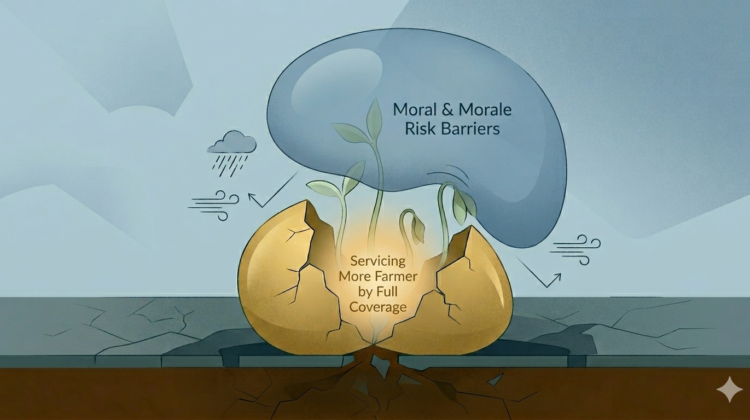
Why Crop Insurance Limits Coverage: Moral Hazard Issue
Introduction: Why Insuring Everything Would Break the System
In agriculture, the instinct is to insure everything. Crops face weather shocks, pest outbreaks, disease, and market swings — and farmers naturally want maximum protection. Yet modern crop insurance systems deliberately limit what they cover.
This is not a flaw. It is a design choice — one grounded firmly in agricultural economics and risk management theory.
The reason comes down to two words: moral hazard. When insurance is too broad, it distorts farmer behavior in ways that ultimately raise premiums, destabilize insurance pools, and undermine the very productivity the system exists to protect.
Understanding why crop insurance limits coverage is essential for anyone working in agricultural risk — from underwriters and reinsurers to agronomists and policy designers.
Moral Hazard vs. Morale Hazard: Two Distinct Risks
These terms are often used interchangeably, but they describe different behavioral problems that emerge when financial exposure is transferred from farmers to insurers.
Moral Hazard involves intentional behavior change. A farmer who knows a yield shortfall is covered may consciously reduce fertilizer application, delay irrigation, or choose a riskier planting date — because the financial downside is borne by the insurer, not themselves.
Morale Hazard is subtler: a gradual erosion of diligence. A farmer may become less attentive to pest monitoring, machinery maintenance, or soil care — not through deliberate calculation, but simply because the safety net reduces the urgency of getting every decision right.
Both forms of hazard emerge from the same root cause: insurance weakens the direct link between effort and financial consequence. In economic terms, incentives become misaligned.
The Economic Core: Asymmetric Information and Hidden Action
At the heart of crop insurance design lies a classic principal-agent problem.
Farmers possess far more information about their daily management decisions than any insurer can realistically observe. This is asymmetric information — and it creates what economists call a hidden action problem.
The logic works like this: high effort means higher input costs and higher expected yield; low effort means lower input costs and lower expected yield. If insurance compensates low-yield outcomes, the farmer may rationally choose the lower-cost strategy. In some scenarios, expected profit actually increases under reduced effort — the insurer pays, the farmer saves on inputs.
At scale, this dynamic increases claim frequency across the entire insurance pool — pushing premiums higher for every participant, including those who manage their farms responsibly.
What Are “Uninsured Items” in Crop Insurance?
To counter hidden action risk, insurers deliberately exclude or only partially cover certain production factors. These are called uninsured items — and they are one of the most important structural features of any well-designed crop insurance policy.
|
Category |
Examples of Uninsured Items |
|
Management Effort |
Weed control quality · Pest and disease monitoring · Timeliness of spraying · Field inspection frequency |
|
Input Decisions |
Fertilizer quantity and timing · Irrigation intensity · Seed grade selection · Pesticide dosage and product quality |
|
Operational Choices |
Planting date · Harvest timing · Soil preparation standards · Machinery maintenance |
|
Labor & Maintenance |
Drainage upkeep · Soil conservation practices · Labor intensity during critical growth stages |
|
These factors remain primarily the farmer’s responsibility. Insurance does not — and economically cannot — fully cover managerial effort without destroying the incentive to exercise it. |
Four Ways Moral Hazard Manifests in the Field
When coverage is too broad, four behavioral shifts tend to follow — all of which harm agricultural productivity:
|
Hazard Type |
How It Manifests |
|
1. Input Reduction |
Farmers apply less fertilizer, pesticide, or irrigation knowing yield losses will be compensated. Increases both loss frequency and average claim size. |
|
2. Riskier Production Choices |
Farmers plant crops poorly suited to soil or choose high-risk planting windows — keeping the upside profit while the insurer absorbs the downside loss. |
|
3. Neglect of Prevention |
Field scouting, soil testing, and routine crop care are the first tasks to slip when a payout is guaranteed regardless of outcome. |
|
4. Claim Optimization |
Deliberately allowing losses to exceed a trigger threshold: reducing harvest effort after partial damage, or skipping rescue irrigation to qualify for a payment. |
|
Importantly, these behaviors are not necessarily unethical. They are rational responses to poorly designed incentives. The problem lies in the contract structure, not farmer character. |
Why Total Coverage Is Structurally Impossible
Three economic conditions make total coverage impossible in any crop insurance system:
Persistent Asymmetric Information
Insurers cannot observe daily management decisions at field level. There is no practical way to verify whether a farmer irrigated on the right day, applied the right pesticide dose, or monitored for pests at the right growth stage.
Prohibitive Monitoring Costs
Continuous on-farm supervision would make premiums unaffordable. The cost of verification would exceed the value of the coverage itself.
The Role of Inputs as Real Investments
Fertilizer, labor, seed quality, and irrigation all require genuine financial commitment. Insurance should stabilize uncontrollable risk — not subsidize insufficient effort. If every yield determinant were insured, there would be no financial reason for a farmer to invest in inputs at all.
Total coverage would not just be expensive. It would actively undermine the production incentives that agricultural insurance exists to protect.
How the Industry Manages the Balance
Insurers address these risks through a combination of contractual safeguards, monitoring technology, and incentive-compatible mechanisms:
- Deductibles and Co-insurance — Requiring farmers to bear a portion of every loss preserves the incentive to invest in prevention. Skin in the game matters.
- Good Farming Practice Clauses — Claims can be denied if poor agronomic management is demonstrated. This creates a contractual floor of responsibility that farmers must maintain to remain eligible for payouts.
- Index-Based Insurance — This approach pays based on objective weather data — rainfall levels, temperature thresholds, satellite vegetation indices — rather than actual yield. Because a farmer cannot influence the weather, the incentive to work hard remains fully intact.
|
Index insurance is one of the cleanest solutions to the moral hazard problem in crop coverage. See our post on parametric crop insurance for how this works in practice. |
The Strategic Role of Uninsured Items: A Feature, Not a Flaw
Uninsured items are not coverage gaps left in by oversight. They are intentional design features that keep the entire system functioning.
By keeping management effort, input quality, and operational decisions outside full coverage, crop insurance achieves five critical outcomes:
- Preserves production incentives across the farming community
- Reduces moral and morale hazard at the portfolio level
- Controls premium costs for all policyholders
- Protects long-term system sustainability
- Encourages responsible, proactive farm management
The ultimate purpose of agricultural insurance is risk stabilization — not income replacement, and not a substitute for agronomic discipline.
Conclusion: Protection Against Physical Perils, Not a Replacement for Farm Management
Crop insurance is designed to protect farmers from uncontrollable physical perils: drought, flood, hail, frost, and extreme weather events. It is not designed — and should not be designed — to insure managerial effort, agronomic skill, or operational discipline.
Strategic use of uninsured items keeps farmers motivated to maximize yield while shielding them from catastrophic, uncontrollable risks. That balance — between protection and responsibility — is what makes crop insurance both economically viable and scientifically sound.
The insurers who design for that balance, rather than simply competing on breadth of coverage, are the ones who build sustainable, profitable portfolios over the long term.
|
The ultimate question is not how much to cover — it is how to align coverage with the incentives that keep agriculture productive and insurance pools solvent. |